Journalism

The Places Between

Year /

2026

Client /

Common Journal

Country /

Denmark

Category /

Editorial Documentary Photography

Kind of Work /

Magazine Feature & Documentary Essay

11
11
11

mnts read

I

Commercial photography usually begins with a brief.

Editorial photography often begins with a question.

When Common Journal contacted me in the spring of 2026, the editor asked something I hadn't been asked before.

"If you could photograph Denmark without photographing landmarks, what would you show us?"

I didn't answer immediately.

Instead, I spent the following week thinking about all the places I pass without really noticing.

A quiet bakery opening before sunrise. A train platform just after the morning rush. A greenhouse hidden behind an apartment building. A bench beside the sea where someone reads every afternoon.

Perhaps those ordinary places reveal more about a country than its famous ones ever could.

two gray and black boats near dock

II

Unlike most assignments, this one came without a detailed schedule. No models. No products. No predetermined locations. Only a notebook containing a list of towns, conversations and observations collected by the editorial team over several months.

Copenhagen. Dragør. Roskilde. Møn. Skagen. Aarhus.

Each destination became another chapter rather than another job. I packed one backpack, two cameras and a notebook. Nothing else.

The project began exactly where my own photography began. Walking. At five o'clock each morning, Copenhagen belongs to very few people. Street cleaners. Bakers. Cyclists. Fishermen preparing small boats along Christianshavn Canal.

The city hasn't yet decided how busy it will become.

One morning I stood on Langebro Bridge watching the first cyclists cross toward the city centre. Nobody noticed me. Nobody needed to. The resulting photograph became the opening spread of the feature. Not because something extraordinary happened.

Because nothing extraordinary happened at all.

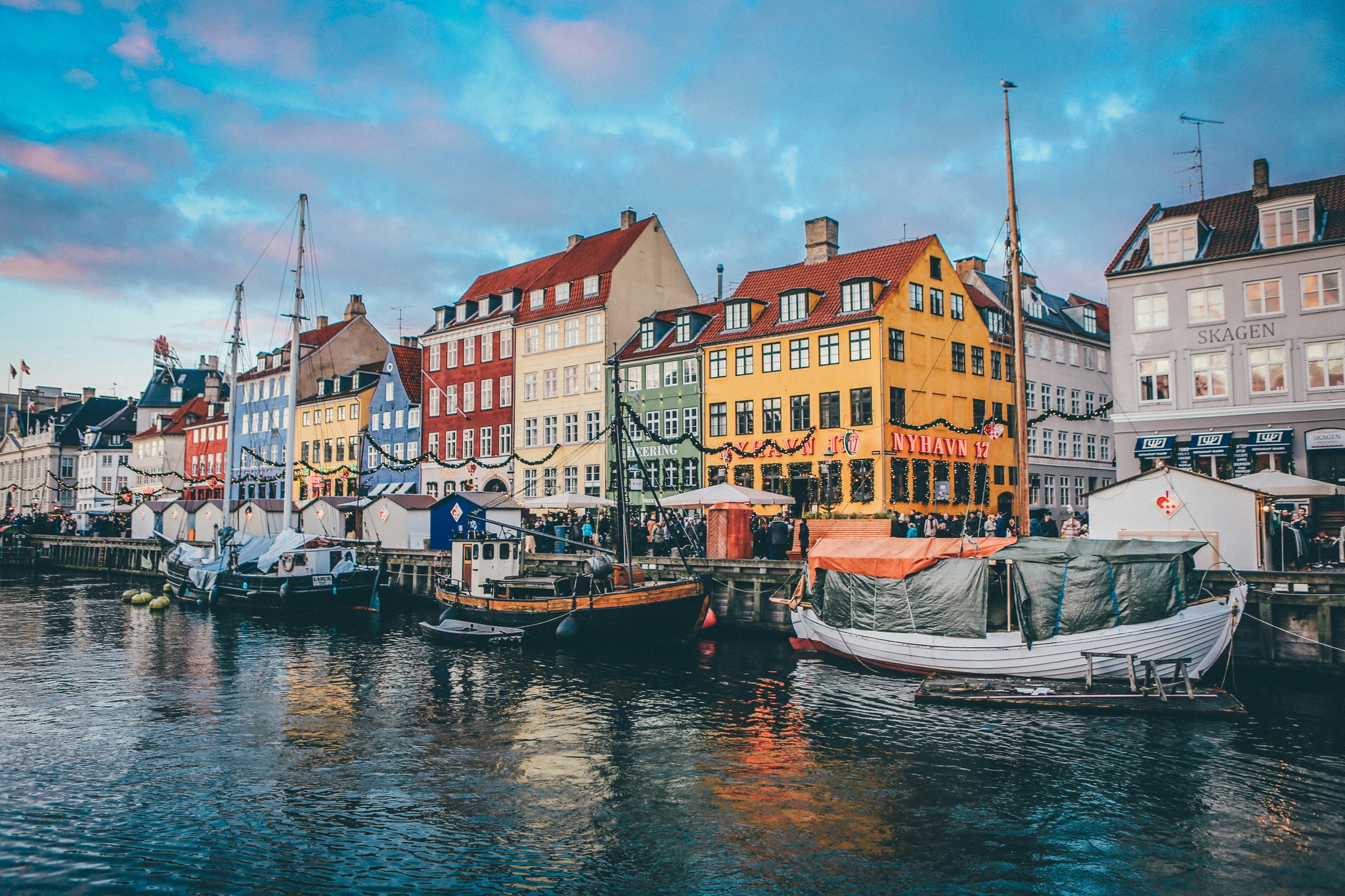
a harbor filled with lots of boats next to tall buildings
a wooden dock over water

III

One of the magazine's writers suggested we visit a small repair workshop in Roskilde. The owner had repaired bicycles in exactly the same location for almost forty years. When I arrived, he wasn't interested in being photographed. He wanted to make coffee.

So we talked. About winters. About old tools. About how the city had changed. Nearly an hour passed before I lifted the camera. By then he had forgotten it was there. Those photographs eventually became some of my favourites from the entire assignment. Trust always appears before authenticity. Never after.

Rain on Møn — Several days later I travelled south to the island of Møn. The forecast promised sunshine. Instead, low clouds covered the coastline from morning until evening. The famous white cliffs disappeared almost entirely behind mist. Many photographers would have considered the weather disappointing. I thought it was beautiful. The landscape became quieter.

Sea and sky merged into one another. People spoke more softly. Rain has a remarkable way of simplifying photographs. It removes distraction. What's left becomes more honest.

The Bakery in Aarhus — Sometimes stories find you. Walking through Latinerkvarteret in Aarhus one morning, I noticed a small bakery where every customer greeted the owner by name. I returned the following day. Then again the day after. Eventually the owner asked why I kept visiting. I explained the assignment. He laughed.

"There's nothing interesting here."

I disagreed. For three mornings I photographed the same routine. Fresh bread emerging from the ovens. Regular customers arriving before work. Children choosing pastries before school. Those photographs never appeared on the cover. Yet readers mentioned them more than any others. Ordinary routines often become extraordinary when someone finally pays attention.

When the journey ended, I returned to my studio with more than six thousand photographs. Instead of editing on a computer, I printed hundreds of small contact prints and spread them across the floor. Looking at photographs physically changes the way I think. Connections become visible.

Stories emerge. Images begin speaking to one another. Slowly, the feature assembled itself. Not geographically. Emotionally. Morning. Movement. Work. Rest. Home.

The sequence felt less like travelling across Denmark and more like travelling through a single day.
several people walking on stairs

"Photography has never been about chasing remarkable moments. It's about noticing them."

brown wooden house on brown grass field under white clouds and blue sky during daytime

IV

The Summer Issue of Common Journal was printed on uncoated paper with generous white margins and almost no captions. Readers were invited to spend time with the photographs instead of rushing through them. Several months later the complete series was exhibited inside Kunsthal Charlottenborg during Copenhagen Photo Week.

Large prints filled the gallery. People moved quietly from one image to the next. Some recognised streets they walked every day. Others recognised themselves. Not literally. Emotionally. That reaction meant more than any review.

People often ask what kind of photography I do. Architecture. Portraits. Editorial. Commercial. Interiors. The truth is, I don't think very much about categories anymore.

I think about attention. Every assignment, regardless of the client, asks exactly the same thing of me. To slow down. To observe carefully. To notice something before it disappears.

Working with Common Journal reminded me that the most meaningful photographs are rarely found in spectacular places. They're found in familiar ones. The chair beside the window where someone reads every evening. The baker opening the same shop before dawn. The cyclist crossing the same bridge every morning. The architect pausing to watch light move across a wall they designed years before.

Photography has never been about preserving extraordinary moments. It's about recognising that ordinary moments are extraordinary already. Perhaps that's why I still carry a camera wherever I go. Not because I'm searching for something unusual. Because I never know when an ordinary Tuesday morning might quietly become a story worth remembering.

Location

Common Journal Editorial Office
Sankt Peders Stræde 38
1453 Copenhagen K, Denmark

green grass field near sea under white sky during daytime
brown wooden house on brown grass field under white clouds and blue sky during daytime
a bridge over a body of water next to tall buildings
a couple of people riding bikes

"Extraordinary stories are almost always hiding inside ordinary mornings."

Usually replying within 1–2 business days.

Usually replying within 1–2 business days.

Photographer based in Copenhagen, Denmark.

Create a free website with Framer, the website builder loved by startups, designers and agencies.